
It's just
a flanger.
14 days to change your mind. Full refund.
Mac & Windows · AU, VST3, AAX Native, CLAP
Hear it flange.
Put Otto on.
Not on everything. A flanger doesn't fit everything. Pick one sound and let it cook.
Snares
Hit the backbeat, or just the last snare of the bar.
1967The Small Faces flanged the whole kit on Itchycoo Park. Two tape machines.
Hats
Give a stiff hat loop some motion. Keep it low or let it go crazy.
Synth leads
Make a plain lead sound expensive.
1977Giorgio Moroder put a flange on I Feel Love.
Pads
Wake up a pad that just sits there.
Ad-libs
Flange an ad-lib or a double. Leave the lead vocal clean.
Samples
Flip it until it sounds like yours.
Into the hook
Run the whole beat through it for one bar. Cut it when the hook lands.
1959The Big Hurt, by Toni Fisher. The first hit you can hear one on.
Guitars
Flange a loop or play right through it.
1981Unchained. One riff, one grey box.
Make
the hook
take off.
14 days to change your mind. Full refund.
Mac & Windows · AU, VST3, AAX Native, CLAP
Sixteen steps. Flange in rhythm.
Flange only the steps you want. Four patterns, locked to your song.

Slams the sweep in on that step.
Freezes the sweep where it is.
That step plays dry.
Nudge Manual left or right on that step.
Bring it back to
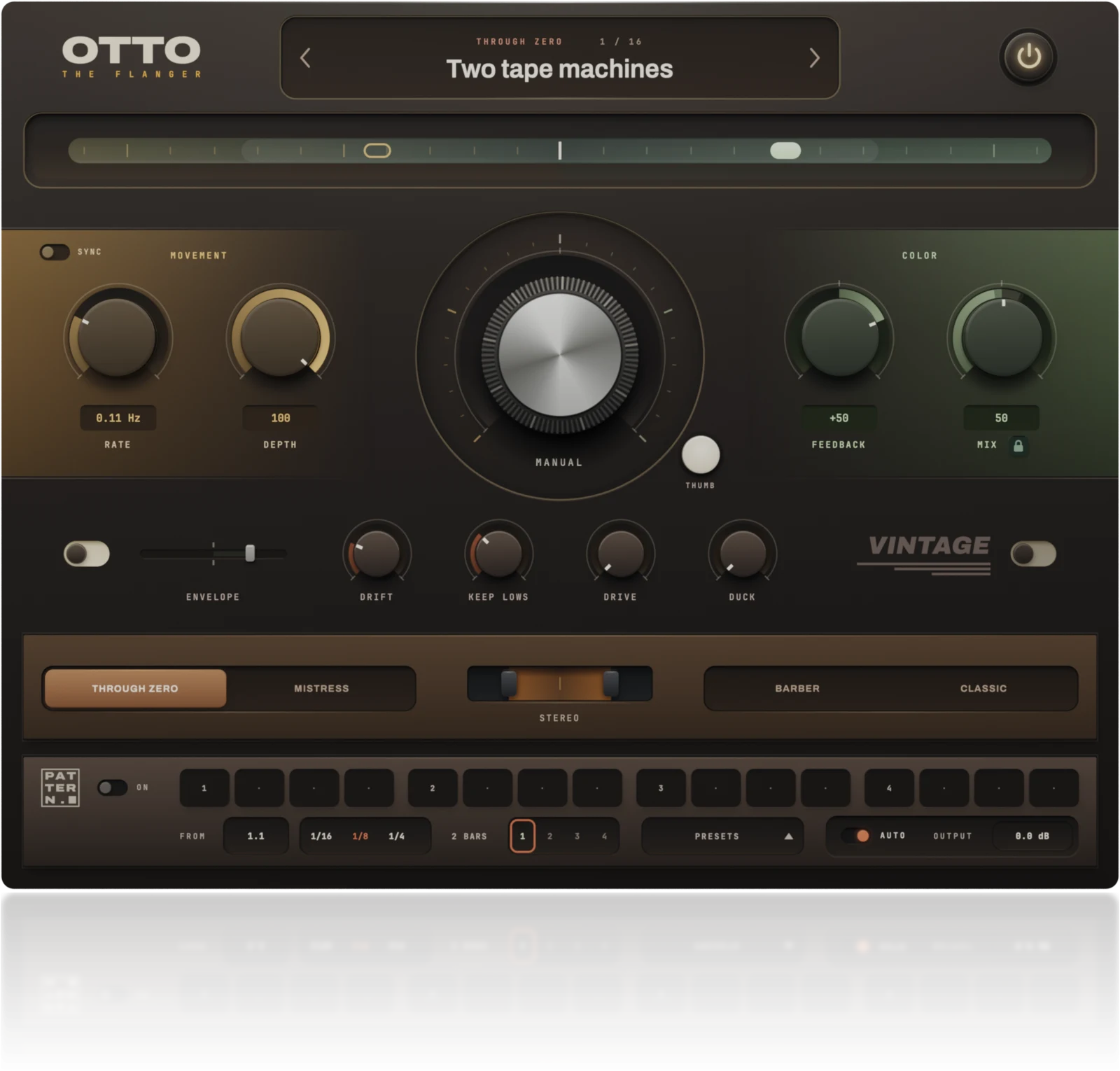
Two tape machines. A thumb on the reel.
Or
A box on the floor. Every guitar on the radio, sweeping.
Through Zero
Two copies of your sound, and the copy can pass the original. Where they line up, the sound cancels, then comes back flipped. Set Manual to the middle and every sweep goes through that point. It is the hardest one here.
Put it onSnares, hats, the bar before the hook.
Mistress
The copy runs through an old delay chip, so it comes out thin and dirty. Push Feedback and it starts to ring on its own. Hit Matrix and the sweep stops: Manual tunes the holes by hand.
Put it onSynth leads, arps, anything you want metallic.
Barber
Four sweeps overlap, and each one fades in as another fades out. Your ear hears it rise forever. Pick Up, Down or Both. Manual is gone here, because stopping it kills the trick.
Put it onThe run into the hook, risers, long pads.
Classic
One copy, a few milliseconds behind your sound. No tricks and no latency. The plain flanger, done right. Slow and wide, or fast and seasick.
Put it onPads, chords, doubles, guitars.
Then fine-tune it.
Nine small controls. An overview.
Sync
Lock it to your BPM, from 4 bars to 1/16.
Envelope
Moves the sweep with the input level. Hit harder, it sweeps further.
Drift
So it never repeats. The sweep wanders a little.
Keep Lows
Worried about the 808? Otto stays off your low end.

Drive
Put some dirt on the sweep.
Duck
Turns the effect down while the input plays. It comes back in the gaps.
Thumb
Hold it and the sweep dives. Let go and it springs back.
Vintage
Flip it for the old hardware sound.
Stereo
From tight to way too wide.
Try it.
Free for 14 days.
On Otto the Flanger
What it is
Otto is a flanger. It plays your sound twice, once straight and once a few milliseconds late, and moves the gap between the two. Where the copies cancel you get holes in the sound, and when the gap moves the holes move with it. That's the whoosh.
There are four machines in it. Through Zero is two tapes, and the copy can get ahead of the original. Mistress is the old green pedal, thin, and it sings on its own when you push Feedback. Barber is the endless sweep, up or down. Classic is the plain one, and the only one with no latency.
Vintage gives each of them a second sound. The tapes become two real decks that wander. The pedal runs on a dying battery and pumps. Barber turns into a rough digital rack from 1988. Classic turns into the grey box, darker on top, with a sweep that hangs high and dives. That makes eight.
The pattern has sixteen steps and follows your song. A step can slam the sweep in, hold it still, play dry or nudge it left or right.
Where to use it
On one sound at a time: a snare, a synth lead, an ad-lib. Or on the whole beat for the bar before the hook. Keep it low and it just shimmers. Turn it up and it's a jet.
Requirements
- macOS
- 10.13 or later, Intel and Apple Silicon. Open the disk image and run the installer.
- Windows
- 10 or later, 64-bit.
- Formats
- AU, VST3, AAX Native and CLAP on macOS. VST3, AAX Native and CLAP on Windows.
- Pro Tools
- 2018 or later, Mac and Windows.
- Internet
- A connection to activate or to start the trial. The installer does not need one.
- Latency
- None on Classic. Through Zero, Mistress and Barber add about 7.5 ms. Your DAW compensates.
- Version
- v1.0.0. The manual covers the install and every control.
- License
- 3 activations. Buying creates your account, where the license and downloads live.
- Seller
- Swedish Sound Group AB, Gothenburg, the company behind Marlow. That is the name at the checkout. Your card statement will read SWEDISHSOUND-MARLOW.